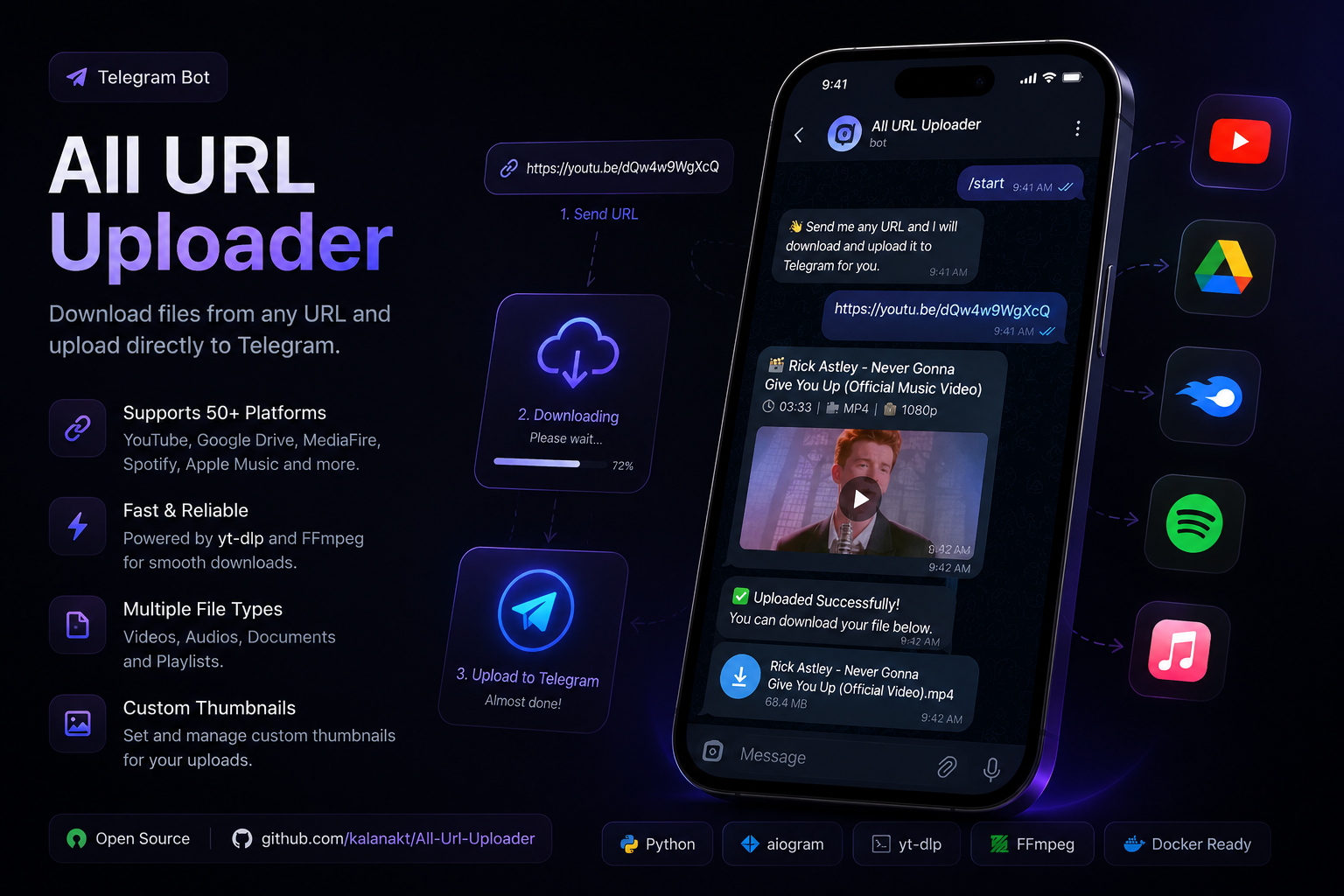
All Url Uploader
A Telegram bot that takes a link, downloads it with the right tool for the job, and sends the file back with the correct media type, metadata, and thumbnail.
Downloading a file on one device to re-upload it somewhere else is a chore that shouldn’t exist. This bot removes the middle step: send it a URL, it fetches the file server-side, and it hands the result back as a proper Telegram video, audio, or document — not an untyped blob.
It’s the most-used thing I’ve published, sitting at 500+ stars and still getting maintenance commits four years after the first one.
What it handles
- Direct file links
url|filenameto rename on the way throughurl|filename|username|passwordfor links behind basic auth- YouTube quick-audio and quick-video downloads
- Format selection for any source
yt-dlpsupports - Per-user custom thumbnails via
/thumband/delthumb
How it works
The bot is built on aiogram, split into routers/ for the Telegram surface and services/ for the work — so the code that talks to users never touches the code that moves bytes. yt-dlp handles anything platform-specific, FFmpeg handles remuxing, and direct links stream through a configurable chunk size rather than buffering whole files in memory.
The parts that actually took iteration are the operational ones. PROCESS_MAX_TIMEOUT bounds external tools so one pathological link can’t wedge the process. A cooldown throttles requests, with AUTH_USERS as an explicit bypass list. HTTP_PROXY threads through both the request layer and yt-dlp, because the sources worth proxying are exactly the ones that block datacenter IPs.
Deployment is meant to be boring: uv for dependencies, a Dockerfile, and one-click templates for Railway, Koyeb, and Heroku. CI runs pytest and pylint on every push, with CodeQL alongside.
Notes
Most of the maintenance is keeping up with extractors — video platforms change delivery formats constantly, and a bot like this is only ever as good as its last yt-dlp bump. The 2026 rewrite moved it to aiogram with uv and a real test suite, which is what made that upkeep sustainable instead of a chore.